
Insights from the Forbes Billionaires List show AI fueling massive wealth growth, tech founders dominating rankings, and Binance’s CZ symbolizing crypto’s influence.
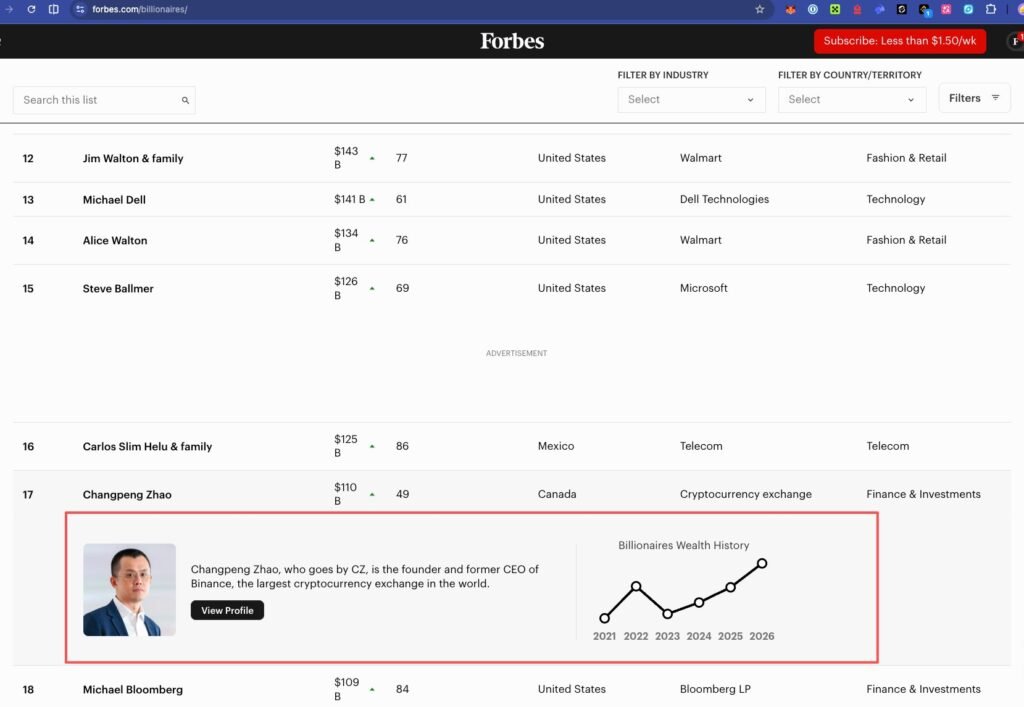
Insights on Wealth Flow Trends from the Forbes Billionaires List
News about @cz_binance
being included in the top 20 of the “pig butchering” scam list is flying everywhere again today. Based on past patterns, it’s highly likely that once CZ wakes up, he’ll start debunking it again, haha.
Not wanting to flaunt wealth is a common mindset among Chinese people, but from the perspective of us onlookers munching on melons, as the sole representative of Crypto breaking into the top ranks, we’re still thrilled to see CZ bringing some pride to the Crypto world.
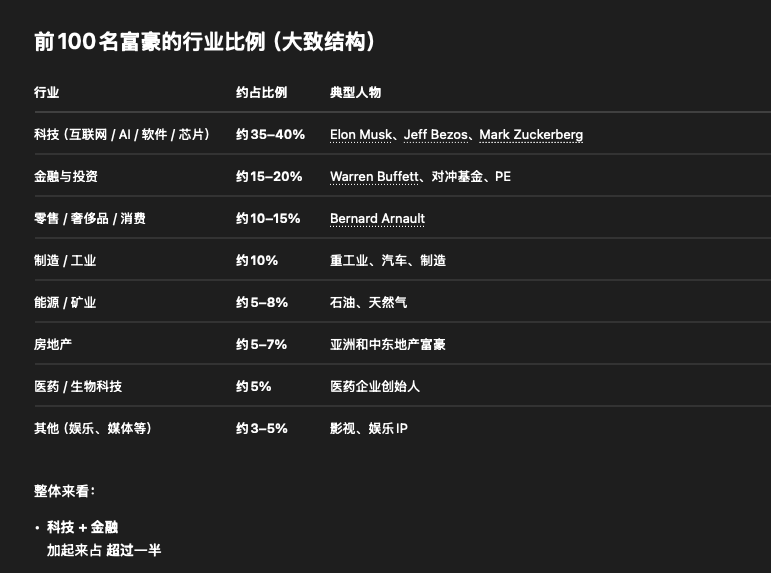
By the way, here’s a quick analysis of the proportions in this year’s billionaires list:
▶️ Tech (Internet / AI / Software / Chips) ~35–40%
Representatives: Elon Musk, Jeff Bezos, Mark Zuckerberg
▶️ Finance & Investment ~15–20%
Representatives: Warren Buffett, hedge funds, PE
▶️ Retail / Luxury / Consumer ~10–15%
▶️ Manufacturing / Industrial ~10%
▶️ Heavy Industry, Autos, Manufacturing Energy / Mining ~5–8%
▶️ Oil, Gas Real Estate ~5–7%
It’s clear that the wealth structure is undergoing generational shifts, and the world is quietly signaling these changes through the flow of wealth.
Here are a few interesting highlights I’ve pulled out:
- AI is becoming the new wealth engine.
Many of the top spots on the list saw wealth growth driven by AI or AI-related tech companies. Musk, Larry Page, Jensen Huang, and others have seen massive increases largely due to the AI boom lifting tech stocks. For example, Alphabet’s stock surge directly boosted Page and Brin’s fortunes.
The past decade’s biggest moneymaker was mobile internet; the next decade’s might be AI infrastructure.
- The pace of wealth growth for super-rich is staggeringly extreme
The list has another jaw-dropping stat:
The number of global billionaires has surpassed 3,400, with total wealth reaching about $20 trillion, and it’s still growing.
Even more outrageous:
The world’s top 10 richest people saw their combined wealth increase by nearly $600 billion in just one year.
The speed at which wealth is concentrating among a tiny few is accelerating further. Is that sci-fi scenario where one person controls 99% of global wealth actually becoming possible?
- Wealth structure is undergoing generational changes
Old money is gradually being overtaken by tech money—for instance, luxury giant Bernard Arnault is being overshadowed by tech founders. Today’s super-rich are mostly tech company founders or controllers, platform empire builders,
not the traditional ones: real estate, oil, manufacturing.
- The super-rich “centibillionaire club” is exploding in growth
The number of centibillionaires (those with $100B+ wealth) has surged. Globally, there are now 18 people with over $1 trillion in wealth—wait, no: 18 with over $100 billion, and this group’s total wealth is nearly $3.6 trillion.
This was almost unimaginable a decade ago.
Many institutions predict the world’s first trillionaire could emerge before 2030.
Additionally, here’s the scoop on billionaires that Chinese folks are more familiar with and interested in:
- The water seller beats the internet whizzes; the top spot is still held by the “Water King”
Zhong Shanshan (Nongfu Spring) remains firmly China’s richest. Amid the global internet winter and e-commerce infighting, the Water King holds strong with essential demand and razor-sharp cash flow control, still outpacing Zhang Yiming and Ma Huateng. - Old Huang represents the glory of Chinese people, sweeping the globe
Riding the AI wave, Nvidia CEO Jensen Huang’s net worth has skyrocketed, landing him in the global top 10 (even top 8). For Chinese readers, he’s the most spotlighted Chinese face in global tech and the absolute godfather of the AI era. - The “Three Overseas Warriors” charge ahead: Earning the world’s money
Zhang Yiming (TikTok), Colin Huang (Pinduoduo/Temu), Chris Xu (Shein). These three are classic winners of “Chinese supply chain + global operations,” showcasing the robust vitality of China’s internet going global. - The end of the real estate era, the rise of new energy/semiconductors
Once-top real estate moguls like Wang Jianlin and Yang Huiyan have seen their rankings plummet or drop off. In their place: Lei Jun (Xiaomi’s car success), Zeng Yuqun (CATL).
Resource-based wealth has been overshadowed by tech-driven wealth.
Circling back to Crypto, CZ’s wealth fluctuations are essentially a barometer for the entire crypto market cycle.
Forbes calculates CZ’s wealth mainly based on Binance equity valuation, not $BNB token price or other on-chain assets.
We’re now in a crypto bear market, with $BNB down 50% from its peak, yet CZ’s net worth has actually risen. I asked an AI about this—it might be because in bear markets, top exchanges actually gain market share.
During the 2018 bear, 2022 bear, and this
Conclusion:
The Forbes Billionaires List highlights a clear shift in global wealth—from traditional industries to technology, AI, and digital platforms. For investors and observers alike, the key lesson is to pay close attention to emerging technologies and long-term trends. Understanding where innovation and capital are flowing today can help individuals make smarter decisions and better prepare for the opportunities of tomorrow. 🚀
Follow our Facebook and YouTube channels to stay updated with the latest news on crypto, finance, technology, and global markets. Don’t miss the newest insights and breaking updates—hit Follow and Subscribe now! 🚀
About The Author