
Library of Congress and National Park Service announce 2025 Holland Prize winners, honoring excellence in historic architectural documentation.
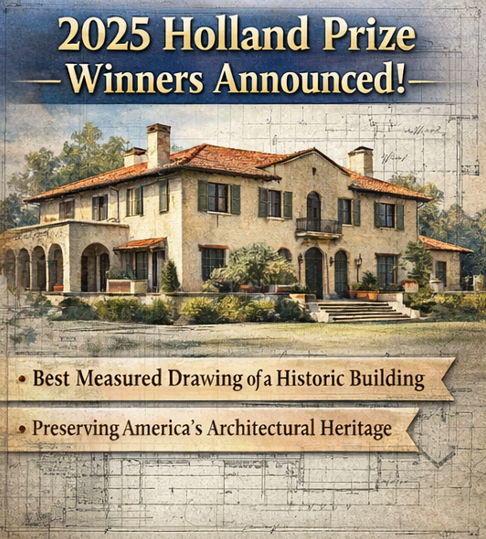
Historic architecture continues to inspire a new generation of designers and preservationists.
In 2025, the prestigious Leicester B. Holland Prize once again shines a spotlight on excellence in architectural documentation. Organized by the Library of Congress in partnership with the National Park Service, the award recognizes the finest single-sheet measured drawings of historic structures in the United States.
This annual competition plays a crucial role in preserving architectural heritage. Through precise documentation, it ensures that significant buildings—whether grand estates or modest landmarks—are recorded for future generations. These drawings are not just technical achievements; they are works of art that capture the spirit, history, and craftsmanship of America’s built environment.
The 2025 edition of the Holland Prize stands out for its remarkable attention to detail and storytelling through design. At the heart of this year’s recognition is a project that blends architectural mastery with historical depth, reflecting both the past and the enduring value of preservation.
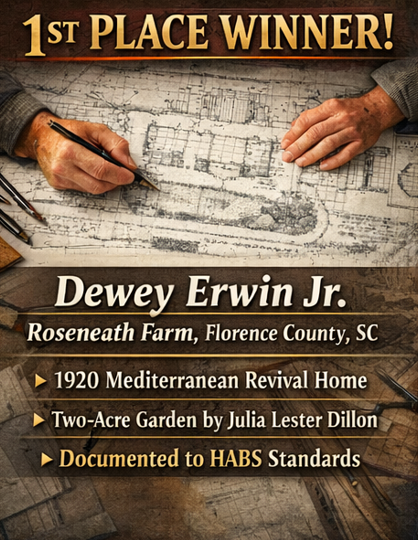
The top honor of the 2025 Holland Prize was awarded to Dewey Erwin Jr., principal of Saluda Architecture. His winning submission documents Roseneath Farm, a historic estate located in Florence County. This project stood out for its exceptional precision, artistic clarity, and deep respect for the building’s historical context.
Originally designed in 1920 by architect William J. Wilkens, Roseneath Farm embodies the Mediterranean Revival style—a design movement known for its elegance, stucco finishes, and harmonious integration with the landscape. Commissioned by businessman Joseph Maner Lawton, the residence reflects the economic optimism and architectural ambition of the early 20th century.
One of the most captivating features of the property is its two-acre walled garden, designed in the late 1930s by landscape architect Julia Lester Dillon. The garden complements the residence with a refined balance of nature and structure, showcasing the importance of landscape design in historic preservation.
Over time, Roseneath Farm underwent modifications, including updates in the 1940s by architect Willis Irvin. These changes add layers to the building’s story, making its documentation even more valuable. Erwin’s drawing captures not only the original design but also the evolution of the structure, offering a comprehensive visual narrative.
The Holland Prize emphasizes accuracy and adherence to the standards of the Historic American Buildings Survey (HABS). Participants must produce highly detailed drawings that meet rigorous technical requirements while also conveying aesthetic quality. This combination of science and art is what makes the competition unique.
Beyond individual recognition, the prize highlights the broader importance of preserving architectural heritage. In a rapidly changing world, historic buildings serve as tangible links to the past. They tell stories of communities, cultures, and craftsmanship that might otherwise be forgotten.
The collaboration between the Library of Congress and the National Park Service underscores a shared commitment to safeguarding these stories. By supporting initiatives like the Holland Prize, these institutions ensure that future generations can study, appreciate, and learn from America’s architectural legacy.
The 2025 Holland Prize highlights the enduring value of preserving architectural history through precision and passion.
Dewey Erwin Jr.’s winning work is more than a technical drawing—it is a bridge between past and present, capturing the essence of a historic site with remarkable clarity.
As the field of architecture continues to evolve, the importance of documentation remains constant. Measured drawings provide invaluable insights for historians, architects, and conservationists alike. They ensure that even if physical structures change or disappear, their stories will endure.
This year’s winners remind us that preservation is not just about saving buildings—it is about honoring the people, ideas, and craftsmanship that shaped them. Through dedication and creativity, architects like Erwin are helping to keep history alive.
In an era driven by innovation, initiatives like the Holland Prize prove that looking back can be just as important as moving forward.
👉 Follow us on Facebook and subscribe to our YouTube channel to stay updated on architecture, culture, and global news!
About The Author